1. We are Legion
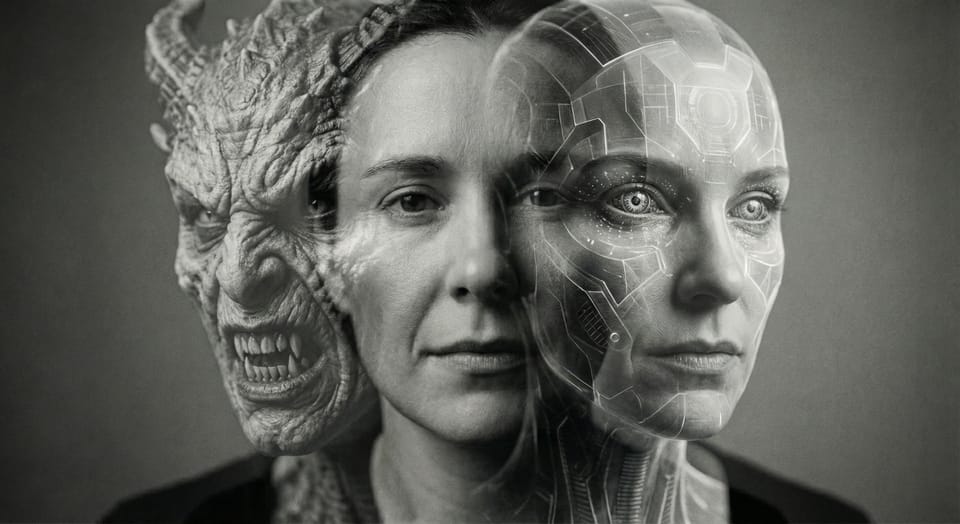
Human beings have been trying to explain their inner conflicts for a very long time. In one age, we created gods that seized control. In another, original sin—a crack in human nature that can never fully be repaired. Later, demons, curses, or witchcraft. Then the unconscious mind: buried drives and repressed memories bubbling up from below. Today, we reach for medical labels—disorders and syndromes. The names change, but the script is the same.
Underneath all those explanations sits the same idea: there is a problem, if you understand and fix it, you can end the inner struggle. No more self-destructive habits. No more late-night spirals. No more dragging yourself through days when your thoughts, feelings, and actions refuse to line up. At last, you’ll be able to live the way you’re supposed to.
We know it must be possible because there are moments, hours, even days when things just work. You’re present and engaged. Your body and mind feel like they’re on the same team. In the zone. In the flow. For a while, everything moves as one.
Then life tilts...
A difficult conversation. Hunger, weather, tiredness, hormones. A throwaway comment that hits a nerve. The same mind that felt whole yesterday now feels broken into warring parts.
But what we experience as a flaw — the thing we assume needs naming and fixing — is exactly how things are meant to be. The brain didn’t evolve as a single, seamless, peaceful entity with one voice and one agenda. It’s a layered construction of systems that developed over millions of years. New circuits grew on top of and into old ones, not to replace them, but to work alongside them.
Fast, emotional systems scan for threat and opportunity. Slower, reflective systems simulate futures and weigh trade-offs. Some parts are tuned to immediate bodily needs, others monitor social approval. They don’t share a single plan or approach. They’re each doing their own job.
From the inside, this architecture feels like a room full of voices and actors. The part of you that wants comfort reaches for the dessert menu. The part that remembers long-term health pushes back. Another part tracks social cues and worries what people at the table will think. Your awareness sits in the middle, trying to make a coherent choice out of messages that all arrived “from within.” When they’re close enough to agreement, you experience yourself as one person. When they diverge, you feel torn—and you call that “the problem.”
Inner conflict isn’t a malfunction.
It’s the normal operation of a complex system. Those pulls and counter-pulls are not evidence that your mind is fractured beyond repair. They’re evidence that multiple specialised subsystems are doing exactly what they evolved to do: protecting you, motivating you, orienting you, learning, each according to its own priorities and history.
Peace isn’t the permanent silence of internal noise. It’s those periods when the parts happen to align—when what you see, what you value, what your body needs, and what you’re about to do are close enough to harmony that your next step feels obvious and unimpeded. That alignment is real, and it matters. But it is also temporary. New information arrives. Needs shift. The loosely coupled parts move independently.
The issue is not that we drift out of alignment. It’s believing that a mind built from many active parts should ever stay aligned. We imagine there is, or should be, a single “true self”. When reality fails to match that fantasy, we decide the system must be damaged—and double down on trying to exorcise or medicate away normal, shifting tensions.
Let's start from a different assumption.
Your brain is not a flawed diamond or a faulty machine. It is a living network of semi-independent, loosely coupled systems, each with its own priorities, all sharing one body and one life. The “you” reading this is not a solitary, unified being. You are the pattern that emerges as those systems negotiate, argue, sync, and resync around what to do next.
We are legion
Our work is not to fix the splits in our mind, or chase the fantasy of permanent inner stillness. Our work is to understand what is happening inside—and learn how to align faster as the world keeps changing.
Let’s start with the first split—the core tension that countless traditions tried to name.
 Jason Bates