3. The map and the territory
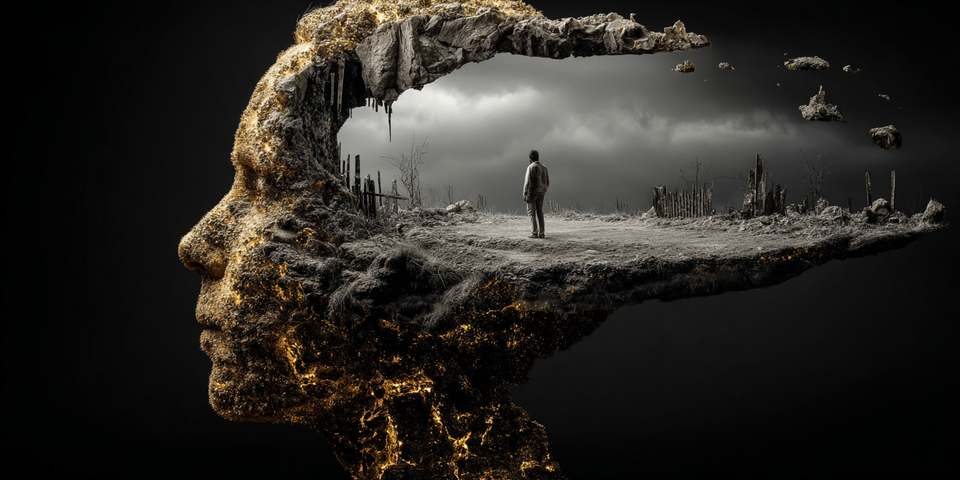
The simplest creatures run on reflex. Stimulus in, response out, nothing retained. But to survive and compete, they need to learn that injury follows this and food follows that. Do more of what works, less of what doesn't. Anticipation is survival.
Evolution led from reflex reactions to early brains. Behavioural patterns built through reward and punishment. The flinch before the strike. The freeze at the predator's approach. Instinctive actions shaped by experience, firing automatically, getting it right often enough to survive.
These learnings merge into an integrated sense of the world. A system that evaluates what to pursue and what to avoid at any given moment. A dark shape overhead and the rustling in the grass cause eyes to widen and muscles to tense. The berries and freshwater stream both come with a felt pull — when danger isn’t close. The drives to seek, to flee, to fight, to mate, all wired in and running in parallel.
Call this the behavioural mind. Ancient and effective, tuned by survival for speed. But only able to react to what's in front of it.
An animal that builds an internal model of the world gains something new. It can navigate toward food, avoid known dangers, move through familiar territory without stumbling into the same mistakes. The animal avoids the predator it can see, but it also avoids the predator it can predict.
Perception sharpened and extended not because the senses improved, but because a model started to help. Augmented perception. Territory the animal can't see guides behaviour as if it were visible.
The animals that developed more sophisticated models survived better. Knowing that food exists at a location is useful. Knowing that food exists at a location at certain times or seasons is more useful still. Evolution built on what came before. The same neural systems that map positions in space started mapping positions in time.
Suddenly the immediate moment opened up. The animal brain could contextualise direct perception with broader vistas of time and space. The perceptual territory grew but was still evaluated against the same internal drives. The food in the distance, in the future, beyond what can be seen, is still sensed as there. It still exerts its pull.
We took this to the extreme. Over roughly two million years, the human brain tripled in volume. We went from predicting a few seconds ahead to thinking years ahead, categorising the world, creating symbols of it, and manipulating those symbols in ever more complex ways.
But beyond a certain time horizon, the tree of possible futures grows so vast that prediction breaks down. The world itself becomes too uncertain. Too many possible futures, no way to know which will arrive. Our minds are still trying to predict, but they're no longer modelling what will happen. They're constructing what might be. Hallucinating. Assembling futures, replaying pasts, building entire worlds that have never existed and might never exist.
This was an extraordinary evolutionary success. The animal that could create potential futures in its head could shape the real one. And through evolutionary pressures the human mind’s modelling system grew far beyond anything that had come before.
But the behavioural mind never changed.
It evolved when everything in awareness was real territory. There was no imagined content, because imagination didn't exist yet. As the modelling system crossed from prediction into creation, the evaluator kept doing what it always did. Content arrives, it responds, reacting to vividness and value, not where the content came from. There is no tag that says "just imagined." There never needed to be one.
This is the architecture. One system assembles content, extending the landscape. The other evaluates and acts on whatever arrives. This is the behavioural mind and the generative mind.
When brain injuries damage the behavioural mind but leave the generative mind intact, people can reason but can't choose. They list every option, weigh every factor, and deliberate forever. Without felt evaluation, nothing resolves.
When brain injuries damage the ability to generate vivid mental imagery, people stop reacting emotionally to imagined scenarios while still reacting normally to real ones. The generative capability is broken. The behavioural mind has nothing to work with.
When the system is working, you feel it. Imagine biting into a juicy yellow lemon. Your mouth waters. Imagine standing up to talk in front of a room of people. Your chest tightens, your stomach drops. One is a piece of fruit you'll never taste. The other is a room you're not in. You know neither is real. The behavioural mind doesn't. It never needed to.
Knowing a scenario is imagined doesn’t stop the Horse’s response. The more vivid, the more likely, the harder it hits.
Every worry you've ever had works the same way. The generative mind assembles a future. The behavioural mind evaluates it. Your body prepares for something that may never arrive. The pain is real. The future isn't.
But every dream you've made happen also started the same way. The pull toward a future that didn't exist yet, felt as real, pursued as real. This isn't a flaw. It's the architecture working exactly as it evolved.
Closer to the present, predictions are grounded. They're checked against what actually happens, corrected, updated. The further the generative mind reaches, the less feedback corrects those predictions. A day from now. A year from now. Five years. Increasing hallucination, decreasing data. No feedback. No correction. But the behavioural mind still responds.
This is where rumination lives. Existential dread. Three in the morning, running the same disaster over and over, with no reality to constrain our projections. Our evolutionary success comes with a psychological cost.
The horse and the rider aren't two entities fighting for control. The generative mind assembles, predicts, models, and hallucinates. The behavioural mind evaluates, motivates, and acts.
But why do we worry in the night, dream of career success over morning coffee, only to feel self-doubt a few moments later? The untethered futures we model, the memories we replay — what decides what the generative mind creates? Something else is shaping what gets assembled.