5. The loop
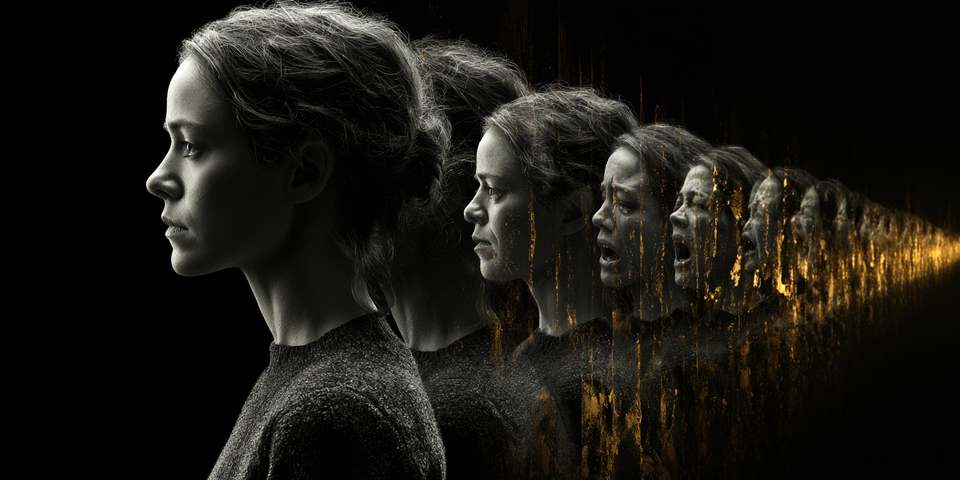
The near miss on the motorway was ten minutes ago. You're home, safe, kettle on. But you still feel wired. Your shoulders are tight.
The meeting ended two hours ago. You're at home watching TV, but not really. You're still back in the office, arguing your point.
You met them last week at a bar, and you can’t stop thinking about them. The way they looked, their laugh. You blush.
Those lingering states aren’t flaws. They kept you and your ancestors safe for millions of years. Anger keeps you ready to fight. Excitement keeps you locked on to the prize. States hang around to make sure the job is done.
Of course they don't last forever. You take a walk and calm down. You sleep and wake up wondering what the fuss was about. States last long enough to be useful, then fade to let you deal with the next thing.
But sometimes the state doesn't fade. You argued with your partner an hour ago. They left the room. The state should be winding down. But your generative mind is still going. Composing the reply you didn't give. Pulling up last month's argument, not yesterday’s kindness. Each remembered slight builds the case that this is a pattern.
We aren't the only animals whose states shape what they project into the world. The scared rat sees escape routes. The hungry crow sees where it buried food last week. But when the rat escapes, it stops planning. When the crow eats, it starts noticing something else. The state did its job. Attention moved on.
Humans are different. Our generative mind evolved from seeing a step or two ahead to reaching forwards and backwards across decades. We think about our thinking, and then think about that. We have foresight that no other animal could dream of.
But that capacity is what keeps us up at night.
When a state is running hot, it shapes what the generative mind creates. Memories arise that match the feeling. Futures grow from it. We aren't enriching our sensed landscape like the crow or the rat, we are creating entirely new scenes, shaped by how we feel. Disconnected from the world out there, we experience our own waking dreams or nightmares.
That is the loop. The feeling shapes the thought. The thought hits you, not as an idea, but as something happening. The feeling deepens. And the deeper feeling shapes the next thought. You don't see it happening.
If the state gets strong enough, you get caught. Your world narrows, you’re transfixed. The same machinery that you use to plan, to rehearse, to think ahead is at work, but your attention is caught. There is no looking away.
Every animal moves through states. Only humans loop.
Loops work in both directions. The 3am worries about what your boss meant. The plans that won't stop coming. The boundaries your friend crossed, replaying her actions until anger is all you can feel. The grief that turns the world grey. Same mechanism, different drives.
And each pass deepens. The third time going over the argument with your partner, it's not frustration any more. It's evidence. They've always been like this. You can see it clearly now. It’s not a thought you're having, it’s how things are.
The state can’t naturally fade while the generative mind keeps feeding it inflammatory content. Loops have to be interrupted. Something outside the loop has to win our attention. Hunger gets loud enough to distract, a work thing pulls you away, or you just get too tired to keep spinning. When we escape the loop, the state fades like states do.
This is why so many traditions begin with the same instruction: return to the body, the breath, the room, the prayer, the present thing. They weren’t against thinking, they were giving us a way out of the loop.
But even when you’re out, the trigger stays hot, primed to run at the next spark. Someone makes an offhand remark and you’re back before you know it. The loop doesn’t need to run forever to do its damage. It just needs to keep coming back. Each repeat is another training run, deepening the groove.
The behavioural mind learns what breaks the loop. A walk. A drink. A scroll. A run. At first, these are just exits. Over time, they become habits. The behavioural mind only cares about what worked, what got us out. This is how addictions start.
With frequent loops, the state lingers between episodes. And from that state, other things catch. The work worry is there, and now the finances look fragile, and your relationship feels off.
Worry is training. We get good at it. What began as something wrong with this situation becomes something wrong with you, with them, with the world, with everything.
The escape habits stop working eventually. There's nowhere to go where some version of the loop isn't. The loop has become the world you live in, and the drink ends the night, not the loop.
Most of us don't end up at this extreme. We move through states, get caught in light loops of excitement and annoyance, with the occasional major tilt, and that's just an average Tuesday.
The more ordinary loops are smaller and more local. A loop doesn’t become your whole world. It attaches to a room, a person, a tone of voice, a time of day.
The work loops fire in the office. The relationship loops fire with your partner in the kitchen. Walk into your parents' house and the loops you had at fifteen are waiting for you.
And once you notice that, you notice something else. It isn’t just the loop that changes. Your attention shifts, your posture, your voice, the things you find yourself thinking about.
You are different people in different rooms.